

The short answer
Choose a toy by three things: your dog’s size, how hard your dog chews, and your dog’s age. Texas A&M’s veterinary college (U.S.) says a good fit is a toy that is not small enough to swallow or fit whole in the mouth, and not so large that your dog cannot chew it comfortably. The Ontario SPCA says no toy is completely indestructible and advises watching your dog during play and replacing worn toys. Bin any toy that starts to lose pieces. Check the Government of Canada’s recalls site before you buy and now and then afterwards. Ask your vet which toys suit your dog, especially a puppy, a senior or a dog with dental disease.
PawTrace is not a vet. This guide shares what we found in the sources listed below; ask your vet about your own dog.
Quick highlights
- Choose a toy by your dog’s size, how hard your dog chews, and your dog’s age.
- A toy that fits whole in the mouth can be swallowed or become lodged in the mouth or throat.
- The Ontario SPCA says no toy is completely indestructible: watch your dog during play and replace worn toys.
- Bin any toy that starts to lose pieces, and check the Government of Canada’s recalls site.
Key takeaways
- Size comes first. A toy that fits whole in the mouth can be swallowed or become lodged in the mouth or throat (Calgary Humane Society, Texas A&M (U.S.)).
- Very hard toys can break teeth. Soft rubber is often safer than extremely firm toys for puppies, seniors and dogs with dental disease (Texas A&M (U.S.)).
- Heavy chewers need tough materials and reinforced seams (Ontario SPCA). Dogs that destroy toys should avoid soft, plush and squeaker toys (Texas A&M (U.S.)).
- Squeakers, stuffing and shredded rope can all be swallowed (Texas A&M (U.S.)). Treat each one as a reason to supervise, and bin the toy once pieces come off.
- Offer a few toys at a time and rotate them. Calgary Humane Society suggests four or five, rotated weekly; Texas A&M suggests one or a couple at a time so you can notice a missing piece.
- The Government of Canada’s recalls site lists pet recalls under “Consumer products – Pet Care/Food”. The Canada Consumer Product Safety Act addresses dangers to human health or safety, and we found no Health Canada safety standard for dog toys, so do not treat a toy as checked because it is on a shelf.
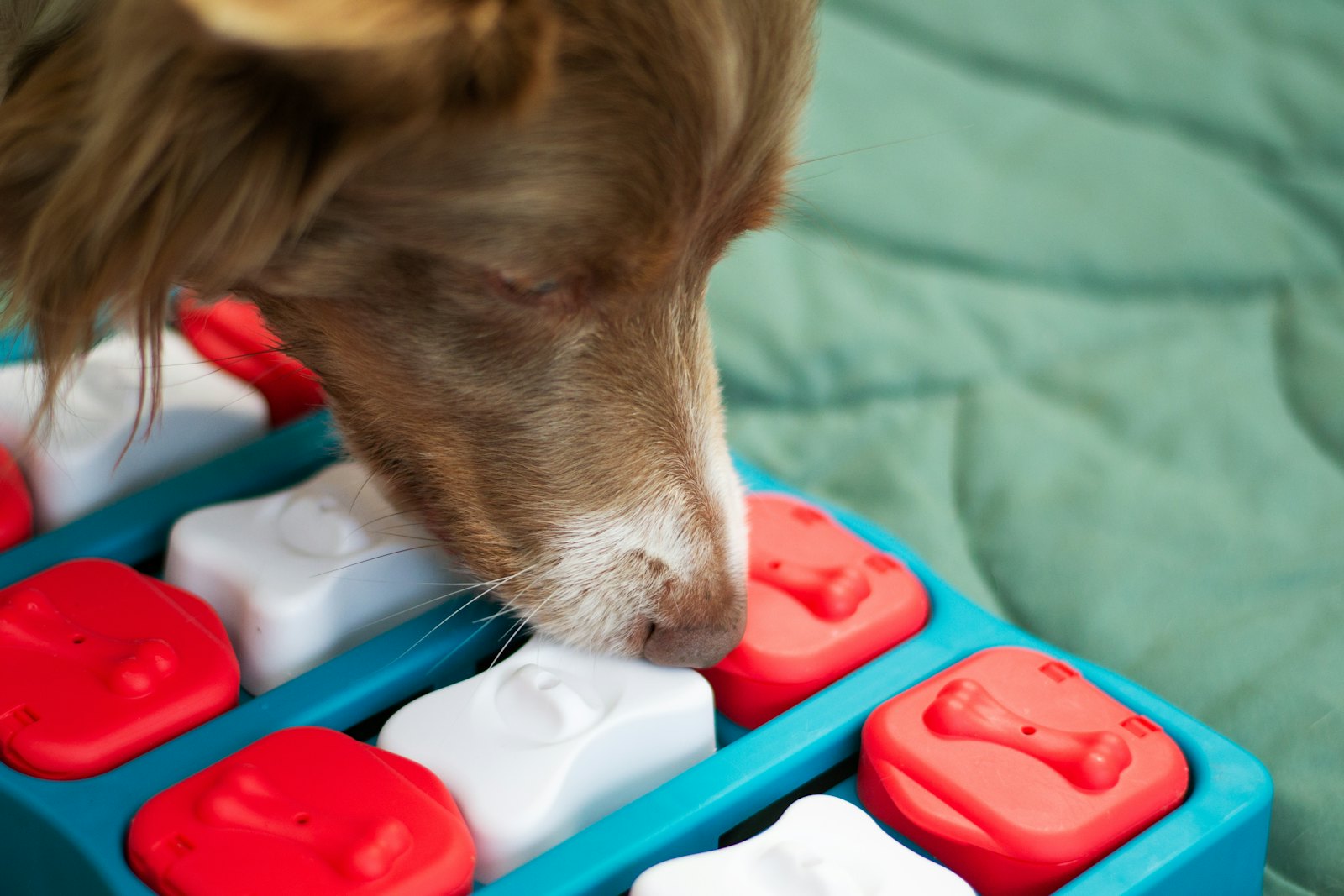
- Food puzzles and treat-dispensing toys give a dog a job. Count the food they hold in the day’s meals.
The six toy types and what each is for
Humane societies and veterinary colleges group dog toys by what the dog does with them. The table sets out each type, who it suits and the risk the sources name. Where we found no source on a point, the table says so.
| Toy type | Suits | Main risk and what the sources say | Source |
|---|---|---|---|
| Chew toys (rubber, nylon, textured) | Teething puppies and dogs that chew to relax | Hardness. Texas A&M says chew toys can be very hard and damage teeth, or soft enough to break apart and be swallowed. Cornell (U.S.) says fractured teeth are commonly caused by chewing very hard objects, and that most veterinary dentists use a thumbnail test for chewing items: you should be able to make a dent in the item with your fingernail. | Ontario SPCA; Texas A&M (U.S.); Cornell (U.S.) |
| Plush (soft) toys | Dogs that carry or cuddle a toy | Not for every dog. Calgary Humane Society says soft toys are not indestructible and should be machine washable. Texas A&M says stuffing can cause a blockage and advises dogs that destroy toys to avoid plush toys. | Calgary Humane Society; Texas A&M (U.S.) |
| Rope toys | Tuggers and dogs that like to chew a knot | Fraying. Calgary Humane Society says some dogs chew through a rope toy in a very short time. Texas A&M says shredded rope pieces may be swallowed or stick in the teeth. | Calgary Humane Society; Texas A&M (U.S.) |
| Fetch toys (balls, discs) | Dogs that chase and return | Size and wear. Calgary Humane Society says a ball that is too small can be swallowed or lodge in the throat, and that tennis balls should be interactive toys only because repeated chewing is not good for the teeth. | Calgary Humane Society |
| Interactive and puzzle toys | Dogs that need a mental job | Broken pieces. Texas A&M says puzzle and treat-dispensing toys engage the mind but must have no pieces that can break off and must be made of non-toxic materials. | Ontario SPCA; Texas A&M (U.S.) |
| Treat-dispensing toys | Dogs left alone for short spells, fast eaters | Calories and supervision. The American Veterinary Society of Animal Behavior (U.S.) says feeding through toys can slow eating, but you still have to monitor the amount fed. It advises supervising and choosing the right size. | AVSAB (U.S.) |
The sources do not agree on hardness. The Calgary Humane Society and Halifax Humane Society (U.S.) handouts call very hard rubber toys safer and longer-lasting, while Cornell (U.S.) and Texas A&M (U.S.) warn that very hard objects can fracture teeth. Ask your vet which suits your dog’s mouth, especially for a puppy, a senior or a dog with dental disease.
Match the toy to your dog’s age
Age changes both the mouth and the need. The sources are clearest on puppies and seniors, and thinner on adults, where the advice is mainly on variety.
| Age | What to look for | Source |
|---|---|---|
| Puppy | Textured chew toys that soothe sore gums, labelled safe for teething. Texas A&M adds that soft rubber toys are often safer than hard toys for puppies. Our teething guide covers what to chew and what to bin. | Ontario SPCA; Texas A&M (U.S.) |
| Adult | Variety. Calgary Humane Society suggests at least one toy to carry, one to roll and one to cuddle, and rotating the set each week. Match the type to what your dog likes to do: fetch, tug or solo play. | Calgary Humane Society; Ontario SPCA |
| Senior | Food puzzles to exercise the mind and nose, a ball you roll instead of throw, and a ball that glows and makes noise if sight and hearing have faded. Texas A&M says soft rubber toys are often safer than extremely firm toys for seniors and for dogs with dental disease. Cornell says to discuss safe activities with your vet at the yearly checkup. | Cornell (U.S.); Texas A&M (U.S.) |
If your puppy is teething, start with our teething survival kit guide. For edible chews, bones and antlers, read our guide to safe chews and bones.
Match the toy to your dog’s size
Texas A&M’s rule has two halves. The toy should not be small enough to swallow or to fit whole in the mouth. It should also not be so large that your dog cannot comfortably chew it. The Ontario SPCA says large breeds may need more robust toys that stand up to powerful jaws, and smaller breeds may prefer smaller, easily handled toys. Its rule of thumb is a toy your dog can carry and play with comfortably.
Re-check the size as your puppy grows. Calgary Humane Society says toys should suit your dog’s current size. A ball that suited your puppy at ten weeks can later be small enough to lodge in its throat; that example is ours. In a home with a small dog and a large dog, Texas A&M advises storing toys away when nobody is playing, so the small dog does not find the large dog’s toy, or the reverse.
Match the toy to your dog’s chewing style
The sources do not define “power chewer” and we found no veterinary threshold for it, so use observation. Watch what your dog does in the first few minutes with a new toy. Halifax Humane Society (U.S.) describes three habits: some dogs carry a plush toy for years, some pull the stuffing out, and some chew a toy apart and swallow the pieces, which creates a safety hazard for that dog. Know which dog you have before you leave a toy with it.
| Chewing style | Look for | Avoid or limit | Source |
|---|---|---|---|
| Carrier or cuddler | A toy small enough to carry and washable fabric; Halifax Humane Society (U.S.) says a toy for shaking should match the size of prey for that dog | Anything with loose eyes, ribbons or strings | Halifax Humane Society (U.S.); Calgary Humane Society |
| Shredder | Durable rubber toys; Texas A&M says a dog that lives to destroy toys should avoid soft, plush or squeaker toys | Plush toys, squeakers, stuffed toys, toys that tear | Texas A&M (U.S.) |
| Heavy chewer | Tough materials, reinforced seams and sturdy construction (Ontario SPCA); balance that against hardness, because very hard objects can fracture teeth (Cornell (U.S.)) | Anything you cannot dent with a fingernail; toys with worn or split seams | Ontario SPCA; Cornell (U.S.) |
| Swallower | Supervision-only play with a toy sized well above the mouth; Calgary Humane Society says treat squeaking toys and chews as supervision-only | Small balls, squeaker toys, anything that breaks into pieces | Calgary Humane Society |
Safety checks to run on every toy
- Size test. Hold the toy next to your dog’s muzzle. If it could fit whole in the mouth, it is too small.
- Squeakers. Texas A&M (U.S.) says squeakers can be swallowed and cause a gastrointestinal obstruction. Calgary Humane Society says a buried squeaker can push a dog to find and destroy it, so treat squeaker toys as supervision-only.
- Stuffing. Texas A&M (U.S.) says stuffing in soft toys can cause an obstruction. Calgary Humane Society says even a child-safe filling is not truly digestible.
- Rope and string. Cornell (U.S.) says string or ribbon can cause more severe damage than other objects by creating holes in the intestine. Cornell does not name rope toys; our reading is that frayed rope strands behave like string, so pull the toy away once it unravels.
- Coatings and additives. Texas A&M (U.S.) advises avoiding toys with additives or coatings, which may be toxic if swallowed.
- Supervision. Stay with your dog when you introduce a toy and for any toy with parts that can come off. The Ontario SPCA advises watching your dog while it plays.
- Fewer toys out. Texas A&M (U.S.) says a single toy or a couple at a time lets you see when a toy is missing pieces, missing completely or falling apart.
When to bin a toy
No source gives a number of weeks or months for a toy’s life, and we found no rule that fits every dog. The sources agree on what to look for:
- The toy breaks into pieces or has pieces torn off (Calgary Humane Society, Halifax Humane Society (U.S.)).
- Eyes, ribbons or strings can be chewed off (Calgary Humane Society and Halifax Humane Society (U.S.) say to remove or avoid them). Split seams, visible stuffing or unravelling rope are our reading of Texas A&M’s advice to inspect toys for wear.
- A tennis ball or similar ball has been chewed through (Calgary Humane Society).
- The toy shows extreme wear. Texas A&M (U.S.) says even the safest toys can break down under play pressure, so inspect regularly.
- A hard toy has chipped edges. Cornell (U.S.) links very hard objects to fractured teeth, and a chipped surface is a sign to retire it. That last step is our reading, not Cornell’s wording.
If your dog swallows part of a toy
Call your vet or an emergency clinic. Texas A&M (U.S.) says to consult your veterinarian if you suspect your dog swallowed any portion of a toy, and notes that a very small amount of stuffing may not trouble a large dog but can trouble a small one. Cornell (U.S.) lists vomiting, loss of appetite, abdominal pain, diarrhea, dehydration and lethargy as common signs of an obstruction, and says obstructions are emergencies that often need surgery. The Merck Veterinary Manual (U.S.) lists lethargy, loss of appetite and vomiting too. Tell the vet what your dog swallowed and when. Our guide to emergency signs lists the other signs that need a same-day call.
Canadian product safety: what Health Canada says
Health Canada’s FAQ on the Canada Consumer Product Safety Act (page modified January 6 2022) defines a consumer product as a product, including its components, parts or accessories, that may reasonably be expected to be obtained by an individual for non-commercial use. It lists products covered by other laws as excluded, such as food, cosmetics, drugs and pest control products. The only pet products the page names are pet grooming products, most of which it says came under the Act on June 20 2011. The page does not mention pet toys.
The same page says the Minister may order a recall if there are reasonable grounds to believe a consumer product is a danger to human health or safety, and that recalls are expected to be mostly voluntary actions by industry. The Act itself (current to September 30 2026) says its purpose is to protect the public from dangers to human health or safety posed by consumer products, and it defines a danger by its effect on a person. Its list of excluded products (Schedule 1) names animals but does not mention pet toys. Health Canada has acted on a pet toy under that human-safety test: on October 10 2025 it advised consumers to stop using a laser toy sold for cats and dogs because the laser posed a danger to human eyes. We found no Health Canada page or rule that sets safety standards for how a toy affects a dog. The Toys Regulations, which set mandatory safety rules for children’s toys, define a toy as “a product that is intended for use by a child under 14 years of age in learning or play”, and their text does not mention animals or pets (regulations current to September 30 2026). A toy’s presence in a Canadian store therefore tells you nothing on whether it was tested for your dog’s safety.
What you can do: search the Government of Canada’s Recalls and safety alerts site. We found pet recalls posted there as Health Canada consumer product recalls in the category “Consumer products (Pet Care/Food)”, and the site offers email and RSS alerts. Check it before you buy an unfamiliar toy and again when a toy has been in your home for a while. If your dog is hurt by a toy, tell your vet first.
Enrichment: why toys matter beyond chewing
The Ontario SPCA says interactive toys stimulate your dog’s mind and help prevent boredom and destructive behaviour. The American Veterinary Society of Animal Behavior (U.S.) says enrichment matters because a dog’s day can be dull, and that food puzzles give dogs a positive experience in getting food. It cites a study finding that feeding through toys rather than a bowl raised activity levels, and it says more research on food puzzle toys for pet dogs is needed. Calgary Humane Society adds that interactive play, such as fetch or hide and seek, lets a dog use up energy in a small space.
Ottawa winters keep many dogs indoors for longer stretches. That is our reading, not a sourced figure. In those weeks, scent games and puzzle feeders are low-cost options. Cornell (U.S.) lists basic scent games indoors, with safe footing, among activities for senior dogs.
Tug-of-war is not off the table. Halifax Humane Society (U.S.) says that with a few precautions and basic rules it can be a fun game: reserve one toy for tug, begin and end the game with set words, and teach your dog to release the toy before you start playing tug. Reserving one toy for tug helps stop your dog from grabbing and tugging whatever else you hold.
Myth vs fact
| Myth | Fact |
|---|---|
| A tough enough toy never wears out. | The Ontario SPCA says no toy is completely indestructible. Texas A&M (U.S.) says even the safest toys can break down under play pressure. |
| The harder the toy, the safer it is. | Texas A&M (U.S.) says extremely firm toys may cause trauma or fractures in puppies, seniors and dogs with dental disease. Cornell (U.S.) links very hard objects to fractured teeth. |
| Tennis balls make ideal chew toys. | Calgary Humane Society says tennis balls are interactive toys only, because repeated chewing is not good for teeth, and to discard one that has been chewed through. |
| A toy sold for dogs has been safety-checked in Canada. | The Canada Consumer Product Safety Act addresses dangers to people, the Toys Regulations define a toy by a child’s use, and we found no Health Canada safety standard for dog toys. Use the recalls site and your own checks. |
| Treat toys are free food. | The AVSAB (U.S.) says you still have to monitor the amount fed when you feed through toys. Ask your vet to set the daily amount if your dog is gaining weight. |
Frequently asked questions
How many toys should my dog have at one time?
The sources differ, so choose a number you can inspect. Calgary Humane Society suggests making four or five toys available and rotating them weekly. Texas A&M (U.S.) suggests one or a couple at a time so you can spot missing pieces. Either way, keep a variety of types: one to carry, one to roll and one to cuddle.
Are plush toys safe for dogs?
They suit some dogs and not others. Calgary Humane Society says soft toys are not appropriate for all dogs and are not indestructible. Texas A&M (U.S.) says to avoid plush toys if your dog lives to destroy toys, because stuffing can cause an obstruction. If your dog carries a plush toy gently, choose a machine-washable one and check seams and eyes.
Are rope toys safe?
Rope toys suit tuggers, but they fray. Texas A&M (U.S.) says shredded pieces may be swallowed or lodge in the teeth, and Calgary Humane Society says some dogs chew through one quickly. Use rope toys with supervision and pull one once it unravels.
Can my puppy use the same toys as an adult dog?
Not always. Puppies need textured chew toys that soothe gums, and Texas A&M (U.S.) says soft rubber toys are often safer than hard toys for puppies. Size is the other limit: a toy sized for an adult may be too large to chew, and a toy sized for a puppy may be small enough for an adult to swallow.
Should I leave toys with my dog when I am out?
Know your dog’s chewing habits first. Halifax Humane Society (U.S.) advises knowing how your dog chews before leaving it alone with any toy, and Calgary Humane Society says squeaker toys and chews should be supervision-only. If your dog swallows pieces, leave only a toy your vet has said is suitable, or none.
Where do I check whether a dog toy has been recalled in Canada?
Search the Government of Canada’s recalls and safety alerts site, which lists pet recalls posted by Health Canada under Consumer products (Pet Care/Food) and offers email and RSS alerts. We found no separate Health Canada listing for dog toys.
Next step
Not sure which toys suit your dog, or worried over your dog’s teeth or chewing habits? Ask your vet. You can search for a clinic on our find a vet page. For trainers and other dog services that can help with chewing and enrichment, see our dog services directory.
Keep reading
- Teething survival kit: what puppies should chew, and what to bin
- Dental care for dogs: brushing, chews and cleanings
- Emergency signs every owner should know
- Senior dogs: signs of ageing and what to do
- Exercise needs by breed group
Sources
All links were checked on October 23 2026. Sources marked (U.S.) are not Canadian.
- Calgary Humane Society: Dog toys and how to use them (2022)
- Ontario SPCA and Humane Society: Selecting the right toy for your dog (February 15 2024)
- Texas A&M College of Veterinary Medicine and Biomedical Sciences (U.S.): Hidden hazards, a guide to the potential dangers of pet toys (November 6 2025)
- Cornell University College of Veterinary Medicine (U.S.): Gastrointestinal foreign body obstruction in dogs (updated December 2024)
- Cornell University College of Veterinary Medicine (U.S.): Risks of a fractured tooth (undated page)
- Cornell University College of Veterinary Medicine (U.S.): Senior dog enrichment (undated page)
- American Veterinary Society of Animal Behavior (U.S.): A guide to using food puzzle toys with your dog (undated page)
- Halifax Humane Society, Daytona Beach, Florida (U.S.): Dog toys and how to use them (undated PDF)
- Merck Veterinary Manual (U.S.): Disorders of the stomach and intestines in dogs (updated June 2026)
- Health Canada: Frequently asked questions for the Canada Consumer Product Safety Act (modified January 6 2022)
- Justice Canada: Canada Consumer Product Safety Act, S.C. 2010, c. 21, section 3 and Schedule 1 (current to September 30 2026)
- Justice Canada: Toys Regulations, SOR/2011-17 (current to September 30 2026)
- Government of Canada: Recalls and safety alerts
General information only. This guide is not veterinary advice. Ask your vet which toys suit your dog. Written by the PawTrace Team.
Keep reading